
Water collecting beside a house deserves a closer look, especially when it returns after ordinary rainfall. A useful drainage plan starts with the source of that water and a suitable route away from the building. It does not begin with assuming that every property needs the same drain.
This guide helps homeowners around Winston-Salem and Mocksville prepare for a drainage assessment. Landscape drainage work can address runoff and wet ground, but it is not a substitute for evaluating structural damage, plumbing leaks or water entering a building.
Record what happens when it rains
From a safe position, photograph overflowing gutters, downspout outlets, ponding beside walls and water arriving from uphill. Note when the wet area appears and how long it remains. Compare light rainfall with heavier storms when possible.
Also note whether the problem appeared after a patio, driveway, planting bed or neighboring project changed. These observations help explain the sequence of events, but they do not establish a diagnosis by themselves.
Check roof runoff and the outlet
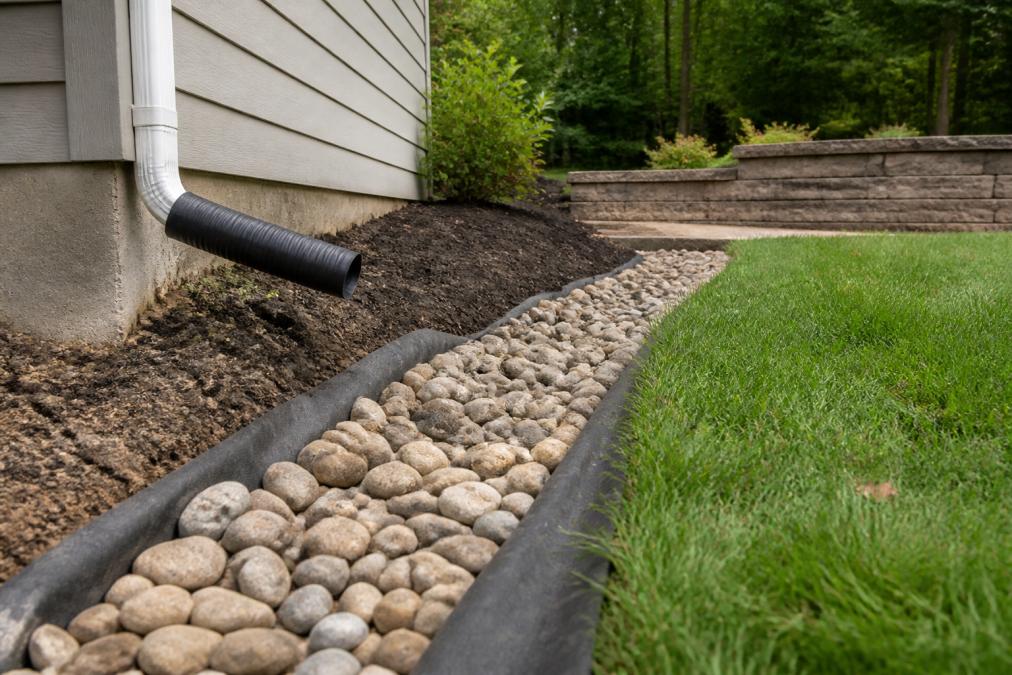
Gutters and downspouts concentrate water from the roof. A blocked gutter or separated outlet can place that water near the house. An extension can help only if its destination is appropriate; moving the outlet into another low spot may simply move the problem.
NC State’s rainscaping guidance describes directing roof runoff toward suitable planted areas. The route should account for soil drainage, nearby structures and overflow. Keep access routes clear and avoid directing concentrated runoff onto neighboring property.
Look at grades and nearby surfaces together
Review the ground, paths, driveway and patio as one system. A surface sloping toward the house or a settled strip beside it may contribute to ponding. The remedy depends on elevations, clearances and where the water can safely discharge.
Do not cover siding, vents or other building details with fill. Have proposed changes checked against the building and local requirements. Excavating beside a foundation requires particular care because buried utilities and structural elements may be present.
Match the drain to the water source
A surface inlet or channel drain collects water flowing across the ground or paving. A French drain uses permeable aggregate and perforated pipe to collect water from surrounding ground. A solid conveyance pipe carries collected water toward an outlet. These components perform different jobs and should not be treated as interchangeable.
Ask the installer to explain why a proposed drain belongs in that location, what it will collect and where it will discharge. Pipe size, trench depth, filter materials and outlet details need to suit the site. A fixed installation depth or completion time cannot be promised from a photograph alone.
For a comparison of broader landscape options, see our seven backyard drainage solutions.
Know when another specialist is needed
If you see new or worsening cracks, movement, repeated water entry or persistent interior dampness, arrange an assessment by a qualified professional appropriate to the problem. Exterior drainage may be one part of the response, but it does not automatically resolve every cause of moisture or structural distress.
Do not enter flooded areas where electricity may be present. For an active emergency, use the appropriate emergency or utility service. Avoid excavation or experimental repairs near the foundation while the cause remains unclear.
Ask for a complete scope of work
A drainage proposal should identify the problem being addressed and the limits of the work. Discuss:
- The observed water source and proposed collection points.
- The discharge location, access and any required approvals.
- Utility locating, excavation and protection of existing structures.
- Materials, cleaning access and restoration of disturbed areas.
- How unexpected site conditions will be handled.
- What the contractor will check at completion and what maintenance is needed.
Ask separately about any warranties and exclusions. Do not assume that a landscape drainage installation includes foundation repair, waterproofing or a guarantee against all future water intrusion.
Maintain and observe after the work
Keep accessible grates and outlets free of leaves and sediment. After rain, observe the route and report new ponding or erosion. Follow the installed system’s maintenance guidance instead of forcing equipment into buried pipe.
Keep photographs and the project scope for reference. They provide a useful record if the landscape changes or the problem returns.
Discuss exterior drainage with P&J
P&J Outdoor Creations LLC provides yard drainage and grading services alongside hardscaping and outdoor construction. Share photographs, the timing of the problem and your goals so we can discuss the exterior work your property may need.
Request a free estimate or call (704) 738-8064, Monday–Friday, 8am–5pm.
Any AI-generated images accompanying this guide are illustrations, not photographs of completed P&J projects.
Frequently Asked Questions
How do I redirect water drainage away from my foundation?
Start by identifying roof runoff, surface slopes and a suitable discharge route. Have changes evaluated for your site and avoid directing water toward buildings or neighboring property.
What is the most effective drainage system for residential properties?
There is no single best system for every yard. The choice depends on the source of water, elevations, soil, outlets and existing structures.
Does exterior drainage work repair foundation damage?
Not by itself. Structural movement or water entering the building requires an appropriate professional assessment. Landscape drainage can be part of a broader solution.
Should I install drainage solutions myself or hire a professional?
Simple observations and clearing accessible debris may be manageable. Excavation, utility conflicts, work beside foundations and uncertain discharge routes deserve qualified help.