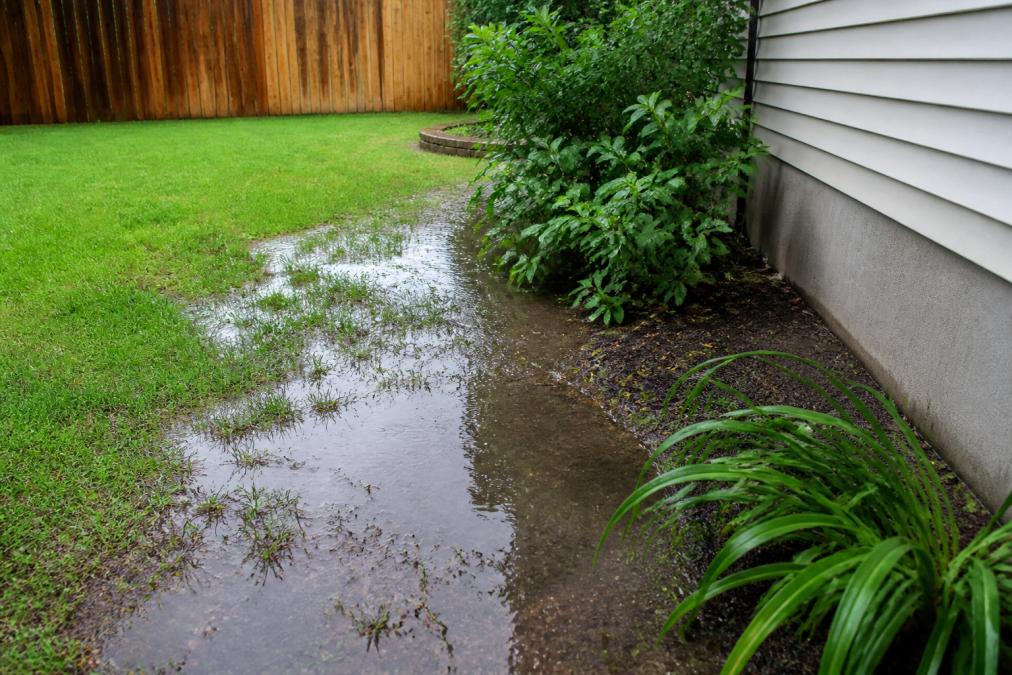
Standing water, washed-out mulch and a patio that stays wet can make your backyard difficult to use. The right fix starts with finding where the water comes from, how it moves and where it can safely go. A drain installed in the wrong place may leave the original problem unsolved.
For homeowners around Winston-Salem, Mocksville, Clemmons and Lewisville, the options below can help frame a conversation about yard drainage. The best choice depends on the property’s slope, soil, available outlet and nearby buildings.
Start by tracing the water
Take photographs during and after rain from a safe location. Note overflowing gutters, downspout outlets, water crossing pavement and low areas that remain wet after the rest of the yard dries. Recurring ponding deserves investigation, but a puddle alone does not identify the soil type or prove a foundation problem.
Before excavation, arrange utility locating and identify private irrigation, lighting and other buried lines. Check local requirements and drainage easements before changing runoff patterns. A drainage plan should avoid sending concentrated water onto neighboring property or toward a building.
1. Clear gutters and redirect downspouts
Start at the roof when wet areas appear near a downspout. Blocked gutters, disconnected elbows or an outlet aimed at a low spot can concentrate runoff. Clear accessible debris safely and have unsafe roof work handled by a qualified professional.
An extension may help move water toward a suitable landscaped area. Its destination matters as much as its length: avoid a route that returns water to the house or creates a slippery walkway. NC State’s rainscaping guidance describes dispersing roof runoff over planted areas where site conditions allow.
2. Correct low spots and grading
Look for settled areas beside paths, patios and foundations. Regrading can improve surface drainage when there is a suitable downhill route, but simply adding soil can transfer the puddle elsewhere.
The slope, fill material and compaction method should suit the location. Foundation clearances, tree roots, utilities and neighboring grades all limit what can be changed. Avoid treating a single slope percentage as the correct specification for every yard or surface.
3. Use a French drain for suitable subsurface problems
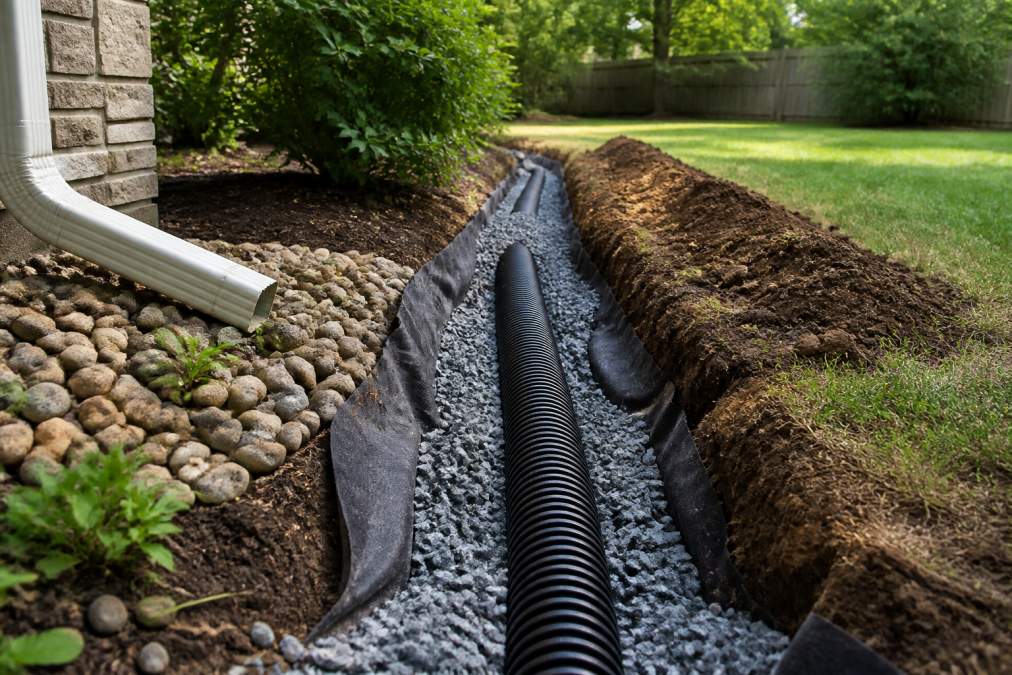
A French drain generally uses permeable aggregate and perforated pipe to collect water from the surrounding ground. It needs an appropriate outlet and a design matched to the soil and water source.
Pipe size, trench depth, filter materials and installation details vary. A generic trench recipe is not a substitute for checking elevations and the discharge location. If the main problem is fast-moving water on a patio, a surface inlet or channel drain may be a better fit.
4. Guide runoff with a swale or dry creek bed
A swale is a shallow landscape channel that guides surface water. A dry creek bed uses stone to create a defined flow path. Both need a planned route and enough capacity for the runoff they receive.
Stone alone does not make water disappear. A poorly placed channel can collect sediment, erode at its outlet or direct water into another problem area. Clay soil does not automatically rule out a swale, but it affects how much water can soak in rather than flow onward.
Explore our drainage solutions if you need help evaluating runoff around your outdoor space.
5. Consider a rain garden where soil and space allow
A rain garden captures runoff in a planted depression and allows it to filter into the soil. It belongs away from the foundation and requires an assessment of drainage, size and overflow. NC State recommends checking that a rain garden drains within three days; persistently wet ground may call for a different design. See its rain garden planning guidance.
Choose this option because the site supports it, rather than simply because a spot is already wet.
6. Collect patio or driveway runoff with a channel drain
A surface channel drain collects water through a grate and carries it through a channel to an outlet connection. It is different from a buried French drain; a perforated pipe inside the channel is not a universal part of its design.
For patios and driveways, the surrounding surface must slope toward the inlet. Choose a system suited to expected runoff and any vehicle loads, and follow its installation requirements. Include access for cleaning and a suitable discharge route.
7. Plan permeable paving as a complete system
Permeable paving can be an option when redesigning a patio or walkway. Its performance depends on the joints, supporting aggregate, underlying soil and drainage design, rather than the visible pavers alone.
It is not a guaranteed cure for a wet yard. Ask how the system will store and release water, whether an underdrain is needed and how its surface will be maintained. See our patio and paver services when planning the wider outdoor space.
Keep the solution working
After storms, check accessible grates and outlets for leaves, sediment and erosion. Keep drainage paths clear and follow the installed system’s maintenance instructions. Avoid forcing tools or high-pressure equipment into buried pipes without knowing their condition.
If ponding returns, investigate the cause instead of repeatedly adding more gravel or soil. Changes uphill, a blocked outlet or settlement may need attention.
Questions to ask before starting
- What is the main source of the water?
- Where will the collected water discharge?
- Will the work affect neighboring property, utilities or existing structures?
- What maintenance and access will the system require?
- What is included in the estimate, including restoration of disturbed areas?
Plan a drainage improvement for your yard
P&J Outdoor Creations LLC provides drainage and grading services alongside patios, retaining walls and outdoor living improvements. Share photographs of the problem and explain when it occurs so we can discuss your property and the work needed.
Request a free estimate or call (704) 738-8064, Monday–Friday, 8am–5pm.